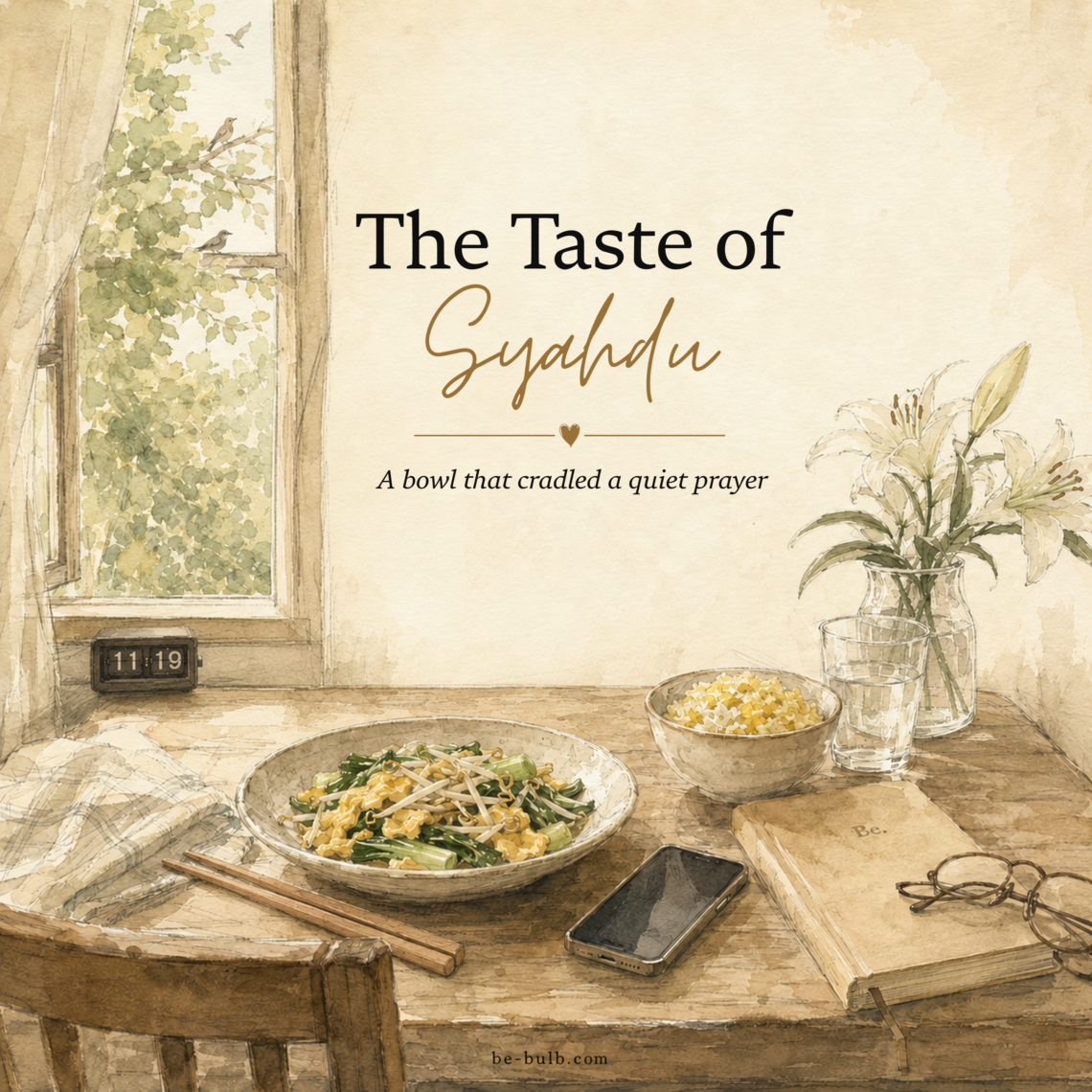
The Taste of Syahdu
This wasn’t the lunch I had planned.
It was the lunch I needed.
That morning had begun with stomach cramps, heavy bleeding, and another reminder that my body was asking me to slow down.
Then my doctor’s nurse called.
My surgery had finally been scheduled.
Suddenly, everything became real.
Not today.
Not next week.
But soon enough.
There was relief in finally knowing the date.
There was nervousness too.
There was no turning back now.
I stood in my kitchen, looked at what I already had, and started cooking.
Two eggs.
Bean sprouts.
Choy sum.
A little garlic.
A little shallot.
Nothing fancy.
But whenever I cook eggs, I follow a little formula of my own:
For every egg, one pinch of salt and one pinch of sugar.
Two eggs meant two pinches of salt and two pinches of sugar.
It is such a small thing, but it has followed me through years of cooking—one of those quiet kitchen habits I no longer have to think about.
My hands simply know.
Lately, I have added something new to the formula: a few drops of sesame oil and a few drops of fish sauce mixed into the eggs.
Not too much.
Just enough.
The sesame oil brings a gentle fragrance, while the fish sauce gives the eggs a little more depth. Together, they make an ordinary egg taste somehow fuller.
I heated the cooking oil until it was very hot, then poured in the egg mixture, allowing the eggs to puff and expand as soon as they touched the oil.
When they were about half cooked, I added the sliced garlic and shallot.
Once they became fragrant, I added a generous handful of bean sprouts and some choy sum. A teaspoon of oyster sauce went in, followed by some chicken stock powder.
I did not measure the chicken stock powder exactly. I rarely do.
I simply added what looked right—probably about a teaspoon—and adjusted the seasoning as I cooked.
When the pan became a little dry, I added a splash of water. The steam helped the vegetables cook gently while preserving a little of their crunch.
The dish was almost finished when I took a small taste directly from the pan to check the seasoning.
And I stopped.
The eggs, bean sprouts, garlic, and choy sum seemed to sing together—not loudly, but gently, like a choir that somehow knew exactly when to begin.
“Hmmm… syahdu.”
In Indonesian, we have a word for moments like that: syahdu.
It is difficult to translate into a single English word.
Syahdu describes something quietly moving—a tender and peaceful feeling that reaches deeper than ordinary happiness or comfort. It can hold stillness, gratitude, longing, and even a touch of sadness, all gently woven together.
It wasn’t excitement.
It wasn’t simply comfort.
And it wasn’t only because the food tasted good.
It was that quiet moment when everything simply felt…right.
The food.
The timing.
The news I had just received.
Once I was happy with the taste, I plated the dish and served it with warm corn rice and a glass of water. I placed everything on the white tray I normally use for my meals and carried it to the table.
Before I began eating, as I always do, I prayed.
But that afternoon, my prayer did not end when I said amen.
As I ate, I continued praying quietly. I prayed that the surgery would go well. I prayed that I would recover with strength and be able to return to my routines and activities again.
The meal did not take away every nervous thought. It did not promise that the days ahead would be easy.
But for that moment, it held me gently.
Somehow, lunch tasted exactly the way my heart needed it to.
When I finished eating, my stomach was full, my heart was grateful, and my prayer was still with me.
I said:
“I am blessed full.”
Perhaps some words aren’t meant to be translated completely.
Perhaps they are simply meant to be felt.
That afternoon reminded me that healing doesn’t always begin in a hospital.
Sometimes, it begins in an ordinary kitchen—with humble ingredients, a warm meal, and a quiet prayer that gently whispers:
Everything is going to be okay.
The Recipe: The Taste of Syahdu
Serves 1
Ingredients
- 2 large eggs
- 2 pinches of salt
- 2 pinches of sugar
- A few drops of sesame oil
- A few drops of fish sauce
- 5 tablespoons of neutral cooking oil
- 2 cloves of garlic, sliced
- 1 shallot, sliced
- A generous handful of bean sprouts, washed
- A handful of choy sum, washed and cut into bite-sized pieces
- 1 teaspoon of oyster sauce
- Approximately 1 teaspoon of chicken stock powder, or according to taste
- A splash of water, if the pan becomes dry
Serve with:
- A bowl of steamed rice—or corn rice, as I had that afternoon
- A glass of water
A Little Note About the Eggs
Whenever I cook eggs, I follow a simple formula:
For every egg, I add one pinch of salt and one pinch of sugar.
Lately, I have also started adding a few drops of sesame oil and fish sauce. The sesame oil adds fragrance, while the fish sauce gives the eggs a deeper, fuller flavour.
You only need a few drops of each.
Method
- Beat the eggs with the salt, sugar, sesame oil, and fish sauce.
- Heat the cooking oil until very hot. Pour in the egg mixture. The eggs should puff and expand as soon as they touch the oil.
- Scramble the eggs until they are about half cooked.
- Add the sliced garlic and shallot. Stir-fry until fragrant and slightly softened.
- Add the bean sprouts and choy sum.
- Stir in the oyster sauce and chicken stock powder.
- Cook until the vegetables are just tender but still retain a little crunch.
- If the pan becomes dry, add a small splash of water. Allow the steam to help the vegetables cook gently.
- Taste and adjust the seasoning as needed.
- Serve immediately with warm rice and a glass of water.
Cooking note: I would not recommend olive oil for this recipe because its distinctive flavour may change the taste of the dish. A neutral cooking oil allows the eggs, vegetables, and seasonings to sing together.
🌿 Be-Bulb Reflection
Life does not always ask us to be strong in loud or extraordinary ways.
Sometimes, strength looks like standing in the kitchen and preparing a simple meal while your heart is carrying both relief and uncertainty.
Sometimes, faith continues quietly between one spoonful and the next.
And sometimes, being gentle with ourselves means allowing an ordinary moment to hold us without asking it to solve everything.
This wasn’t a recipe created to impress anyone.
It was a meal made from what I already had, on an afternoon when everything seemed to arrive at exactly the right time.
The phone call.
The prayer.
The warm corn rice.
The eggs.
The bean sprouts.
The choy sum.
The garlic.
They didn’t shout.
They sang.
And somehow, lunch tasted exactly the way my heart needed it to.
That was the taste of syahdu.
Be. Nourished.
Be. Gentle.
Be. Comforted.
Be. Grateful.
Keep the Faith.

Be.
Curious by choice. A planner at heart. Sharing stories about life, travel, wellbeing, faith, and the little lessons that help us grow. Be curious. Be kind. Be the light.

